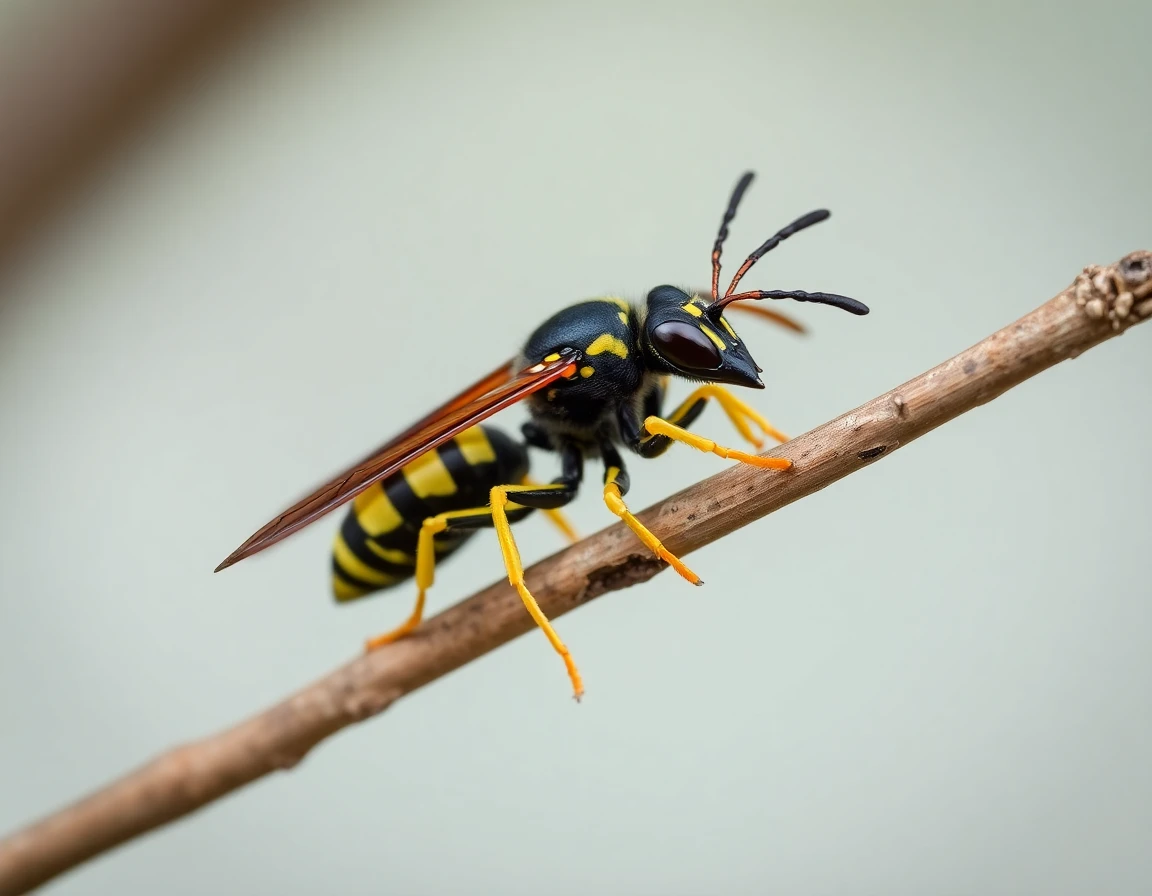
Invasive species — urgent response required
Asian Hornet (Vespa velutina) in French-speaking Switzerland
The Asian hornet is an invasive predator devastating honeybee populations and increasingly present across French-speaking Switzerland. If you suspect a nest, contact us immediately — do not attempt removal yourself.
Report a NestWhat Is the Asian Hornet?
Vespa velutina nigrithorax, the Asian or yellow-legged hornet, is an invasive species originally from Southeast Asia that was accidentally introduced to France around 2004. Since then, it has spread progressively northward and eastward, and has been confirmed in Switzerland in recent years — including in the cantons of Geneva, Vaud, Valais and Neuchâtel.
Asian hornets are not significantly larger than European hornets (typically 25–30 mm for queens, 20–25 mm for workers), but they are darker — predominantly black/dark brown with a characteristic dark brown to black abdomen and a single yellow-orange band. Their legs are yellow at the tips, giving rise to the alternative name "yellow-legged hornet."
The primary ecological concern is their devastating impact on honeybee populations. Asian hornets hunt honeybees with remarkable efficiency, hovering in front of hive entrances and decapitating returning foragers at the rate of dozens per hour. A single nest in the vicinity of an apiary can cause the collapse of multiple bee colonies during the foraging season.
How to Identify an Asian Hornet Nest
Primary nests (spring)
Small, rounded, walnut-sized nests built by the founding queen in early spring. Often found in dense shrubs, under eaves or in sheltered outdoor corners. These are small and rarely dangerous at this stage.
Secondary nests (summer–autumn)
By summer, the colony moves to a new, much larger nest — a spherical or tear-drop shaped structure of grey papery material, often 50–80 cm in diameter or larger. Typically built high in trees (10–20 m up), but also in roof spaces and outbuildings.
How to distinguish from a European hornet nest
- — Asian hornet nests are usually much higher up in trees than European hornet nests
- — The nest entrance is typically on the side (not at the bottom) of the structure
- — Asian hornets are darker overall than European hornets
- — If you cannot get close enough to see these details safely, contact us for identification
Risks and Why You Should Not Act Alone
While a single Asian hornet sting is comparable in severity to a European hornet sting (painful but not uniquely dangerous for most people), a disturbed colony can deliver hundreds of stings in a matter of seconds, triggering anaphylactic shock even in individuals with no prior allergy.
High-altitude nests present an additional physical hazard — removing a nest at 15–20 metres in a tree requires specialist access equipment, and any intervention at height while being attacked by hornets is extremely dangerous.
Most cantons in Switzerland now have reporting systems for Asian hornet sightings, and in some cases cantonal authorities contribute to the cost of nest destruction given the species' ecological impact. We can advise you on the reporting requirements and available support in your canton.
Our Asian Hornet Nest Removal Method
Identification and risk assessment
We confirm species identification, assess nest size, location and accessibility, and plan the safest approach for removal — including any specialist access equipment required for high nests.
Treatment in full protective equipment
Our technician approaches the nest in a full bee suit and applies approved insecticide to the nest entrance and structure. The treatment is typically carried out at dusk or early morning when the colony is most settled and the maximum number of hornets are inside the nest.
Nest removal and reporting
Once the colony is confirmed dead, the nest structure is removed. We provide documentation of the intervention for your records and, where required, report the sighting and treatment to the appropriate cantonal authority.
Report an Asian Hornet Sighting
If you have seen an Asian hornet or suspect a nest, contact us immediately. Include any photos if possible.
Need a pest control expert?
Contact us for a free, no-obligation quote. We respond quickly throughout French-speaking Switzerland.
Get a Free Quote