Insects
Wasp Nest: When Should You Call a Professional?
Where wasps build their nests, when it becomes dangerous, and why you should never tackle one yourself.
The Wasp Season in French-speaking Switzerland
In French-speaking Switzerland, the wasp season follows a predictable pattern. After overwintering, queen wasps emerge in spring (March–April) to establish new nests. The nest grows throughout spring and summer as the colony expands. Worker populations peak in August and September, when wasp activity is at its most intense and aggressive. With the arrival of the first frosts (usually October–November), the colony dies off naturally.
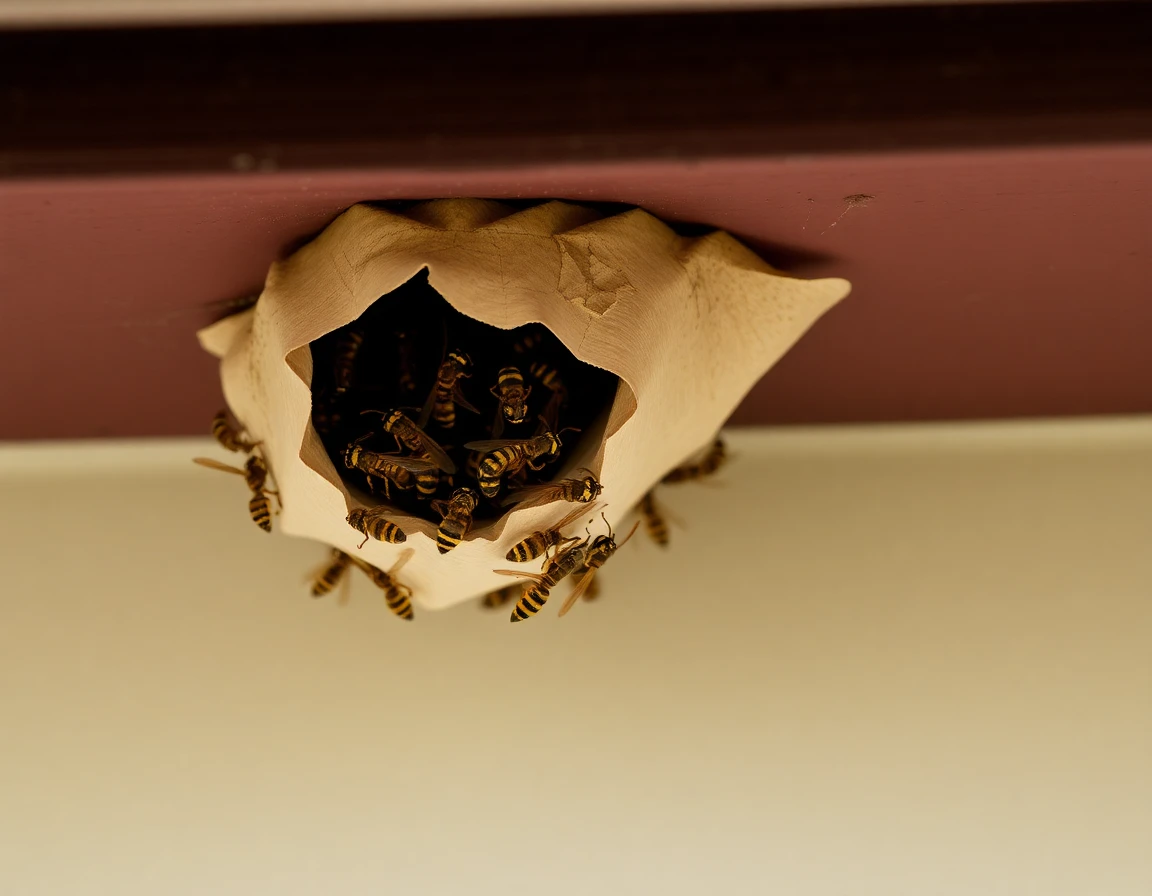
The two most commonly encountered species are the common wasp (Vespula vulgaris) and the German wasp (Vespula germanica). Both are social insects that build paper-like nests from chewed wood fibres. A mature colony in late summer can contain between 5,000 and 15,000 workers.
Where Do Wasps Build Their Nests?
Wasps choose sheltered, warm locations that offer easy access to the outside. Common nesting sites include:
- Roof spaces and attics: Often built in roof insulation or tucked against roof beams — sometimes growing to the size of a football or larger by late summer.
- Wall cavities: Wasps can enter through small gaps in brickwork, ventilation bricks, or under roof tiles and build nests inside wall voids.
- Garden sheds and outbuildings: A favourite location — the entrance may be an inconspicuous gap under a door frame or a crack in the timber.
- Under roof overhangs and eaves: Open, aerial nests are visible and often found here.
- Underground: Some species (Vespula) nest in underground burrows, often in garden lawns or soft soil near walls.
- Compost heaps and thick hedges: Dense vegetation provides concealment for smaller colonies early in the season.
When Does a Wasp Nest Become Dangerous?
Not every wasp nest requires professional intervention. A small nest in an out-of-the-way location — the far corner of the garden, a tree at the edge of your property — may pose minimal risk if left undisturbed. However, professional removal is strongly recommended in the following situations:
The nest is inside or directly on your building — in the attic, wall cavities, or under roof overhangs close to windows or doors. Colony growth can cause structural damage and the nest entrance may be directly in a doorway or high-traffic area.
Children, elderly people, or individuals with known insect venom allergies are regularly in proximity to the nest. A single sting can trigger anaphylaxis in sensitised individuals — a medical emergency.
The colony is large (late summer). Wasp colonies become increasingly aggressive as the season progresses and food competition intensifies. Worker numbers peak in August–September.
The nest has already been provoked — if wasps have stung people nearby, the colony is already in a defensive state and further attempts to interfere will escalate the danger.
You have been unable to locate the nest entrance — a hidden nest inside a wall or underground burrow is particularly dangerous because it can be disturbed accidentally. Do not probe or seal suspected openings yourself.
Why You Should Never Tackle a Nest Yourself
Every year, people suffer serious injuries — and occasionally fatalities — from attempting to remove wasp nests without professional equipment. Here is why DIY removal is strongly discouraged:
- No protective clothing: Consumer-level bee suits provide inadequate protection from a disturbed colony of thousands of workers. Professionals use full sealed suits, gloves, and respiratory protection.
- Ineffective products: Supermarket wasp sprays have a very limited reach and do not penetrate deep into the nest. They are unlikely to kill the entire colony and will provoke an aggressive defensive response.
- Risk of spreading the colony: A disturbed nest that is not completely destroyed will disperse, with workers potentially establishing a new satellite nest nearby.
- Fire risk from improvised methods: Using flames or fire to destroy a nest — a dangerous and illegal practice — can result in house fires, especially with nests inside roof spaces.
- Hidden nests: Attempting to seal a nest entrance traps the workers inside, who may then chew through plasterboard or internal walls into your living space.
What a Professional Intervention Involves
A professional wasp nest treatment typically involves a single visit. The technician locates the nest entrance, applies a fast-acting insecticide directly into or onto the nest, and confirms the colony has been neutralised. The physical nest is removed where accessible; where this is not possible (e.g., inside a wall), the dead colony is left in place and the entrance sealed once activity has completely ceased.
Most treatments take under an hour. Depending on the location and size of the nest, re-treatment may occasionally be needed. Our team covers all of French-speaking Switzerland and can typically intervene within 24 hours.
Need a pest control expert?
Contact us for a free, no-obligation quote. We respond quickly throughout French-speaking Switzerland.
Get a Free Quote